
How Arrest Warrants Work in Adair County
Every Adair County arrest warrant starts with judicial review. Under Iowa Code section 804.1, a criminal proceeding may open with a complaint filed before a magistrate. If the complaint or its supporting affidavits establish probable cause that an offense occurred and that a designated person committed it, the magistrate issues a warrant unless another procedure applies. A citation may be used instead in some cases. Probable cause simply means facts strong enough for the magistrate to reasonably believe both the offense and the identity claims. Once signed, the warrant gives a peace officer authority to arrest the named person. It does not end the case. The prosecution must still prove the case through the normal court process. Willfully missing an appearance required by a citation can also bring an arrest warrant for failure to appear under Iowa law. People often call that a bench warrant. The phrases overlap, but a failure-to-appear warrant differs from a new probable-cause warrant in an Adair County courtroom.
Adair Complaint-to-Warrant Timeline
A warrant in Adair County changes hands more than once. Each hand-off leaves its own paper trail, which is why no single public screen ever shows the whole path.
- A complaint and any supporting affidavits go before a magistrate or authorized judge.
- The judicial officer reviews probable cause and chooses a warrant or another lawful process.
- The warrant carries required identity, offense, issue, signature, and possible bail details.
- The Clerk records or forwards the order, while law enforcement receives a service copy.
- A Sheriff, city officer, state officer, or other Iowa peace officer may serve it.
- The officer returns the warrant to court, and the arrested person goes before an accessible magistrate without unnecessary delay.
Once Adair County serves, hears, or recalls the warrant, look in two places: the Clerk's case file and the Sheriff's service record. One can lag behind the other.
Arrest Warrants: What They Contain
Iowa Code sections 804.2 and 804.3 spell out what an arrest warrant must contain. Rule 2.36 adds the Iowa District Court caption and the criminal case number. Adair County publishes no local warrant-number prefix or status code of its own.
| Court and case | Iowa District Court caption and criminal case identifier. |
|---|---|
| Named subject | Defendant name if known, or a lawful description when permitted. |
| Offense | Name or general description of the alleged offense. |
| Issue information | Date and Iowa city or county of issuance. |
| Direction | Command addressed to Iowa peace officers. |
| Signature | Magistrate signature and official title. |
| Bail | Endorsement when the warrant is bailable. |
The public Adair County docket may display the 17-character Iowa case ID while the warrant order itself stays closed. A case number alone says nothing about service status.
Restricted Adair Arrest Warrant Papers
The Iowa Judicial Branch keeps arrest-warrant applications and orders restricted until execution and return or initial appearance, unless a court orders otherwise. That rule shields process that has not yet been served. It also explains why a public Adair County search can skip the warrant itself. The public case entry may still offer a clue.
Access rule: No public document does not prove no warrant exists; confirm status with the Clerk and Sheriff.
Bench-warrant papers, search-warrant files, juvenile records, and active-investigation material each carry their own access limits. Ask Adair County for the public docket instead of demanding a sealed affidavit. Under Iowa Open Records Law, Iowa Code chapter 22, you can send a request to the lawful custodian, but the law never forces release of protected material. If a record is withheld, ask which rule or statute applies. The Clerk holds the court file. The Sheriff holds the law-enforcement copy and any service information.
How Warrants Get Served in Adair County
Iowa Code section 804.4 lets a warrant go to any peace officer, and service can happen in any Iowa county. For holding and service questions, the Adair County Sheriff is the main county contact. Greenfield Police works out of the same Public Safety Center. City or state officers may also serve a warrant within their authority. The official Sheriff's page lists the county service contact.
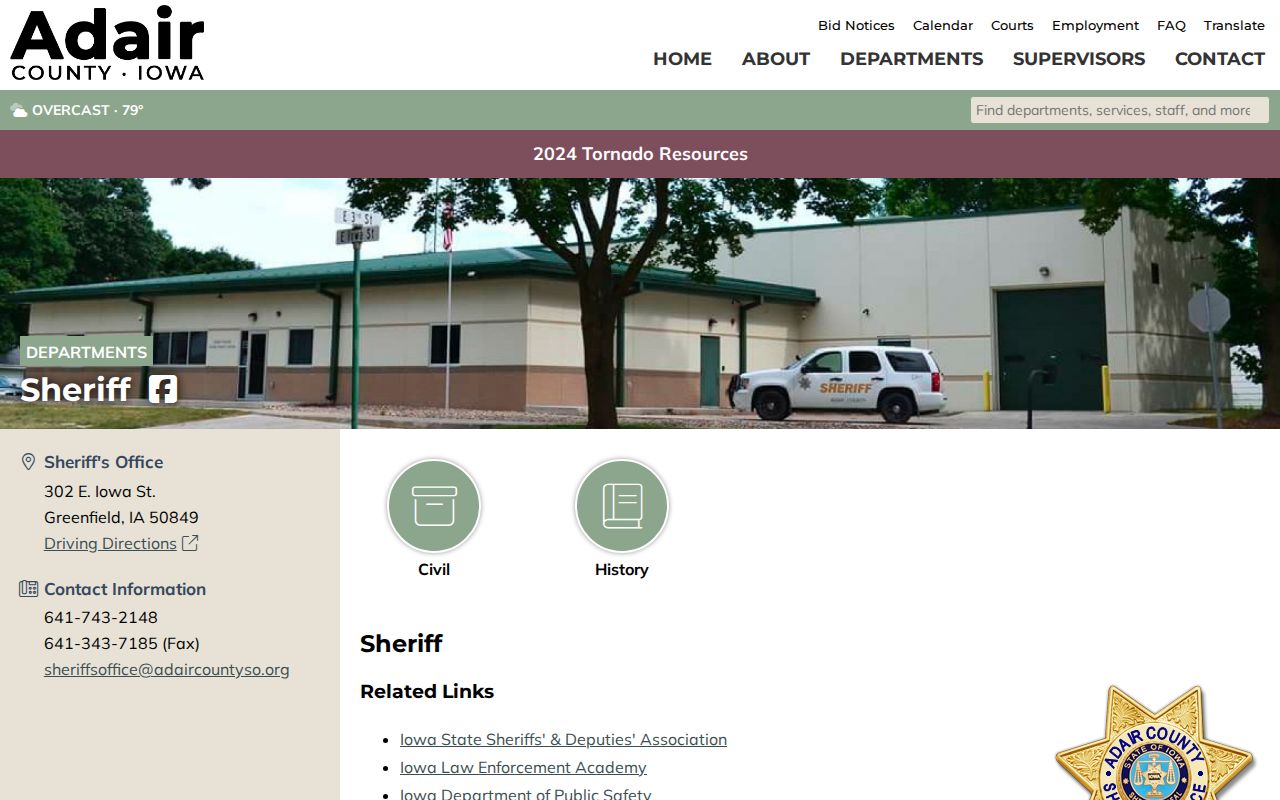
The Sheriff's Office sits at 302 E. Iowa St., Greenfield, IA 50849. Call 641-743-2148, fax 641-343-7185, or email sheriffsoffice@adaircountyso.org. The county posts no warrant sergeant, service schedule, warrant line, or city-by-city breakdown. After an arrest, Iowa law requires presentation before the nearest or most accessible magistrate without unnecessary delay. That phrase is not a fixed hour count. Bail and release turn on the warrant, approved procedures, and judicial action.
Adair Sheriff and Greenfield Police
The Adair County Sheriff and the Greenfield Police both work out of the shared Public Safety Center, but their files stay separate. The sheriff answers county service questions and holds county records. City policing belongs to Greenfield Police. For Iowa District Court case action, the Clerk is still the office to ask.
| Agency | Confirmed role | Contact |
|---|---|---|
| Adair County Sheriff | County holding and service questions | 641-743-2148 |
| Greenfield Police | City policing from shared center | 641-743-2323 |
| Clerk of Court | Case file and issuing-court action | 641-743-2445 |
| IOWA System agencies | Restricted statewide connectivity | No public portal |
The IOWA System links over 450 justice agencies for wanted-person and NCIC checks. That network is not open to the public. An Adair County warrant search still runs through the sheriff or the clerk, each answering a different question.
Arrest Warrants, Summonses, and Bench Warrants
An arrest warrant commands custody. A summons tells a person to appear without being arrested on the spot. A bench warrant usually follows a missed duty in an existing case. Because of Iowa's failure-to-appear arrest-warrant rule, a bench warrant in Adair County may still carry arrest-warrant language in the court record.
| Feature | Arrest warrant | Summons | Bench warrant |
|---|---|---|---|
| What it orders | Arrest | Appear as directed | Arrest after missed duty |
| Usual basis | Probable cause | Charge handled without custody | Failure to appear or comply |
| Issuer | Magistrate or judge | Court or authorized process | Judge or magistrate |
| Response | Attorney, surrender, bond, appearance | Attend on time | Recall, reset, bond, appearance |
No label alone shows current status. Read the newest event, then confirm with the issuing Adair County court and the holding agency.
Adair Warrant Bond Is Case-Specific
Iowa publishes a uniform bond schedule for certain releases when courts are not in session and approved procedures apply: $25,000 for a class B felony, $10,000 for class C, $5,000 for class D, $2,000 for an aggravated misdemeanor, $1,000 for a serious misdemeanor, and $300 for a simple misdemeanor. Those are statewide reference amounts, not an Adair County warrant quote. The official uniform bond schedule states the qualifying context.
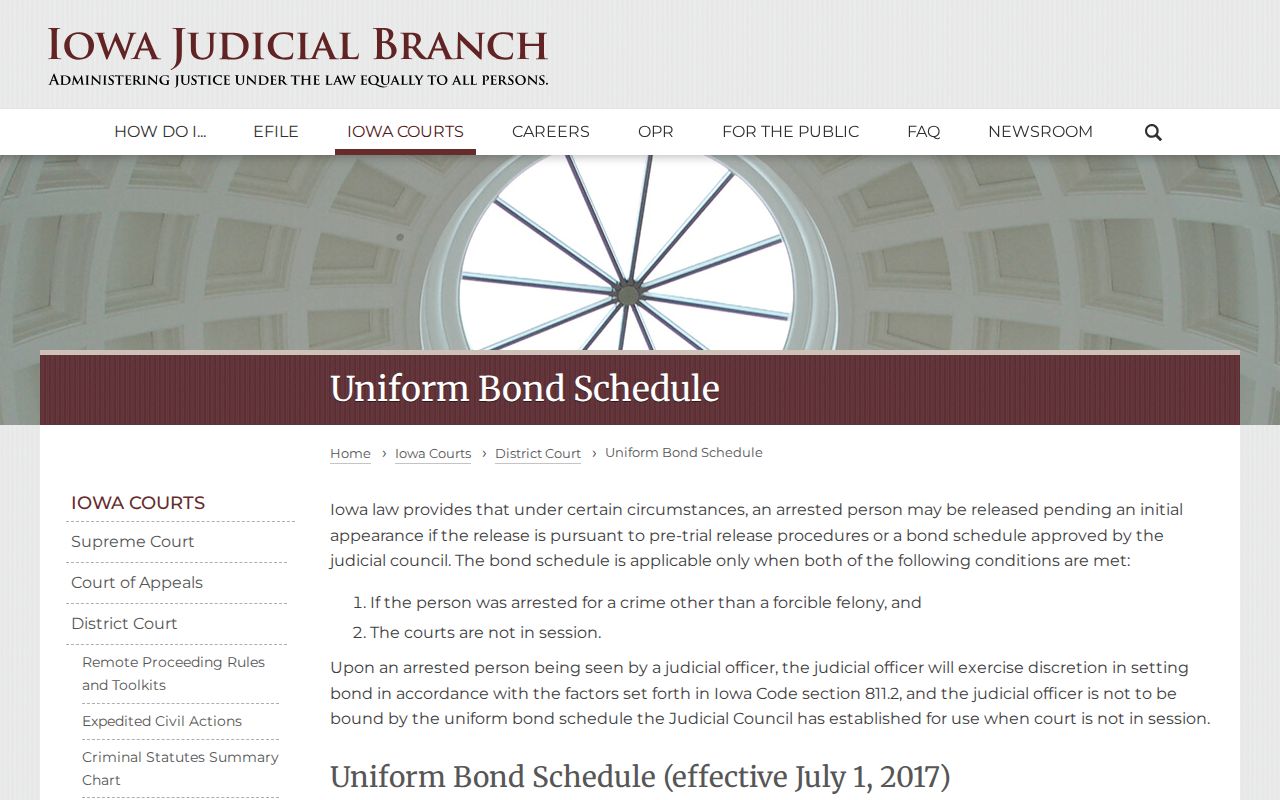
Every case gets its own bond terms. A judicial officer can reset them once you appear. A forcible felony or a separate hold changes the picture. Before you post anything, ask whether bail is endorsed on the warrant, whether a magistrate must act first, what payment the office takes, and where it must be paid. Adair County posts no bond window, card policy, intake rule, or online bond portal, and paying a fine through Iowa Courts Online does not count as bond.
Handling an Arrest Warrant in Your Name
Do not walk into the Public Safety Center on an unverified name match. Search Iowa Courts Online first. Write down the case details. Then call the Clerk at 641-743-2445 and the Sheriff at 641-743-2148, and ask which Adair County court controls the warrant and whether a planned surrender can be arranged.
- Confirm identity, the case ID, the issuing court, and active status.
- Consult an attorney about appearance, surrender, bond, or a motion to recall or quash.
- Ask the Clerk what the judge requires and whether payment is allowed.
- Ask the Sheriff about reporting location, timing, booking, and service.
- Keep receipts and orders, then confirm the court and service records updated.
Important: Plan surrender and bond with an attorney, the issuing court, and the Sheriff before arriving at an unpublished walk-in desk.
Adair County publishes no walk-through instructions, surrender sheet, recall form, bond method, or amnesty event. Ask the clerk rather than guessing at those details.
Adair Arrest Warrant Return Records
Serving a warrant does not close the file. The officer returns the warrant and service paperwork to the issuing court. The arrested person goes before a magistrate, who takes up bail or release. From there the case runs until the court resolves it.
- Executed
- The arrest authority was carried out.
- Return
- The officer filed service information back with the court.
- Initial appearance
- The first judicial review after arrest under the warrant.
- Recalled
- The issuing court withdrew the warrant.
- Quashed
- The court set the warrant aside, though the underlying case may remain.
Once an appearance, bond, service, recall, or quash order happens, call both offices again. Ask the Clerk whether the return or order is in the docket. Ask the Sheriff whether its service copy has cleared. A federal warrant moves on a separate track. Adair County sits in the Southern District of Iowa, and PACER may show docket clues, though a federal warrant can stay sealed. Federal fugitive process belongs to the U.S. Marshals Service, not a county warrant search.